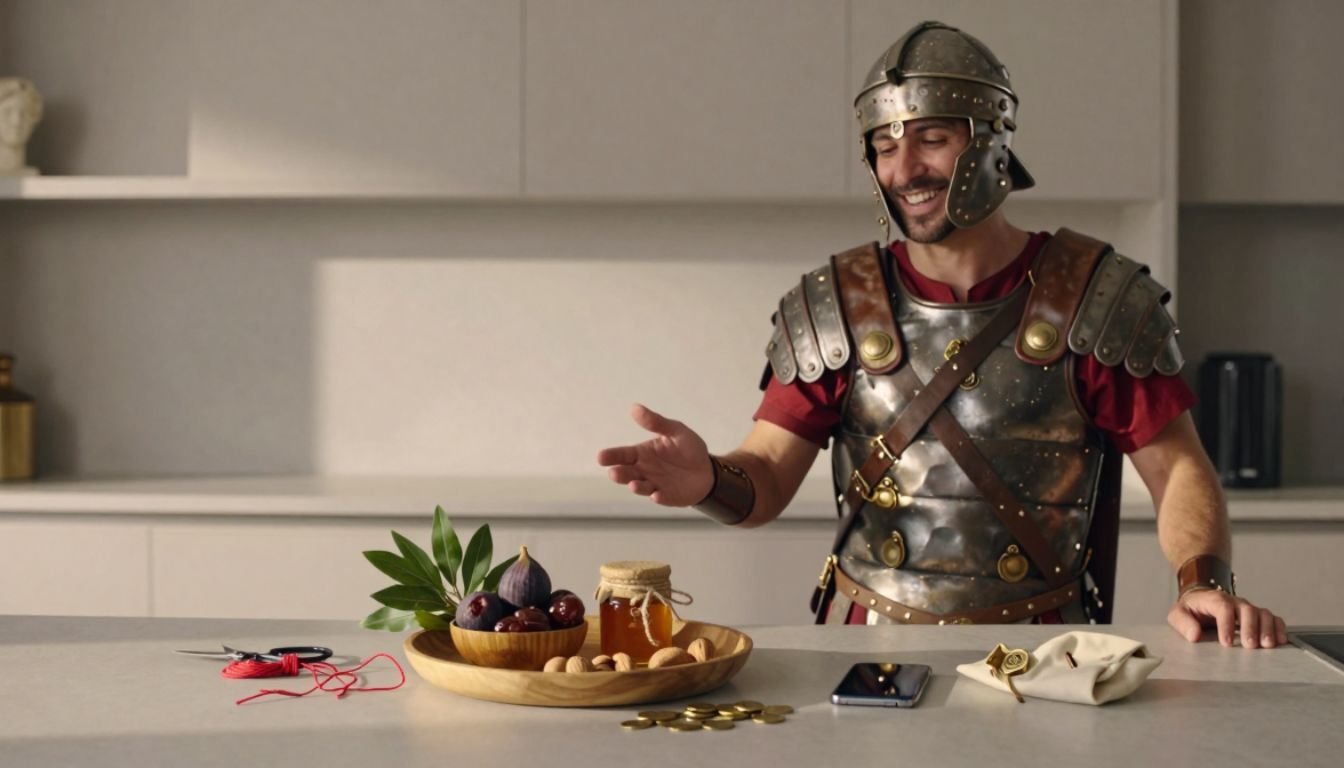
The Romans had a ritual every January 1st that would feel right at home in your group chat: exchanging small, meaningful gifts to wish each other prosperity for the year ahead. No credit card debt. No performative generosity. Just a symbolic token and a single word of intention.
It wasn’t about the price tag—it was about the meaning you attached to it. And in 2025, as we’re all craving connection that doesn’t require a second mortgage, this ancient tradition is worth stealing.
What Romans actually gave (and why it worked)
On the Kalends of January, Romans exchanged gifts called strenae—branches from a sacred grove, honey, figs, dates, and later, small coins stamped with the god Janus. The gift wasn’t the point. The wish was.
Each item carried symbolic weight. Honey represented sweetness in the year to come. Figs symbolized abundance. Coins weren’t currency—they were tokens of fortune, stamped with the two-faced god who looked backward at the old year and forward to the new.
What made it work: the giver named the wish out loud. No guessing. No generic card. You handed over a dried fig and said, “I wish you abundance in your work this year.” Done.
The simplicity forced clarity. You had to choose one thing you actually wanted for that person. Not everything. Not a list. One word. One hope.

The modern version: a one-word wish + a $5 token
Here’s the structure. You can execute this in five minutes, in person or over video.
Step 1: Each person picks one word they want for themselves in the new year. Not a resolution. A quality. Examples: rest, courage, clarity, play, boundaries, momentum.
Step 2: Each person picks one word they wish for someone else in the group. Think about what you’ve noticed them struggling with or reaching for.
Step 3: Exchange a small, physical object that represents the wish. It doesn’t have to be expensive. It has to connect to the word.
Step 4: Say the wish out loud when you hand it over. “I’m giving you this candle because I wish you more rest this year.” That’s it. No speech. No explanation.
The token anchors the wish in the physical world. It’s harder to forget a intention when it’s sitting on your desk.
How to do this without it feeling awkward
The biggest barrier isn’t the idea—it’s the fear of sincerity. We’re not used to naming what we want for each other.
Here’s a script that works:
If you’re hosting: “I want to try something for New Year’s. It’s based on an old Roman tradition—everyone brings a small gift, under $10, and we each say one thing we wish for each other in the new year. Nothing fancy. Just one word and a token. In and out in 20 minutes.”
If you’re participating: Keep it short. “I picked this for you because I wish you [word] this year.” Then stop talking. Let it land.
If someone gets emotional: Let them. This tradition works because it’s sincere. A two-second pause is not awkward—it’s the point.
Set a time limit. Five minutes to pick your words beforehand. Two minutes per person to exchange. Structure kills awkwardness.

10 token ideas under $10 that still feel personal
You’re not trying to impress anyone. You’re trying to match the symbol to the wish. Here are ideas that work:
- A small candle (wish: rest, peace, warmth)
- A pack of wildflower seeds (wish: growth, patience, new beginnings)
- A smooth stone from a craft store (wish: grounding, stability, calm)
- A small notebook (wish: clarity, creativity, reflection)
- A keychain or charm (wish: protection, courage, adventure)
- A bar of nice soap or lotion (wish: self-care, gentleness, renewal)
- A packet of tea or coffee (wish: energy, ritual, slow mornings)
- A single nice pen (wish: focus, intention, follow-through)
- A small plant cutting or succulent (wish: resilience, growth, life)
- A printed photo or postcard (wish: memory, connection, joy)
The key: explain the connection when you hand it over. The object is meaningless without the word.
Why this works better than resolutions
Resolutions are private, vague, and easy to abandon. This ritual is public, specific, and relational. Someone else has named a quality they see in you or want for you. That changes the stakes.
It also flips the script on gift-giving. Instead of guessing what someone wants and hoping you’re right, you’re naming what you notice about their life. That’s intimacy.
The Romans understood something we’ve forgotten: a wish is a gift. Saying “I want this for you” out loud is an act of care. The token is just proof it happened.

How to adapt this if you’re doing it solo
No group? No problem. The structure still works.
Version 1: Write down one word you want for yourself. Buy or find a token that represents it. Put it somewhere you’ll see it daily—your desk, your bathroom mirror, your car.
Version 2: Mail a token and a note to someone you care about. One sentence: “I’m wishing you [word] this year.” No explanation needed.
Version 3: Create a small “wish altar” on a shelf or windowsill. One object per person you’re thinking of, each representing a word. Update it as the year unfolds.
The ritual doesn’t require an audience. It requires intention.
The takeaway: symbolism over spending
The Roman tradition endured for centuries because it was simple, repeatable, and meaningful. It didn’t require wealth. It required attention.
In a culture that equates care with cost, this is a quiet rebellion. You’re saying: I see you. I know what you need. Here’s a $3 candle and a wish. That’s enough.
Try it this week. Pick one person. One word. One token. Say it out loud. The awkwardness will last five seconds. The memory will last longer.