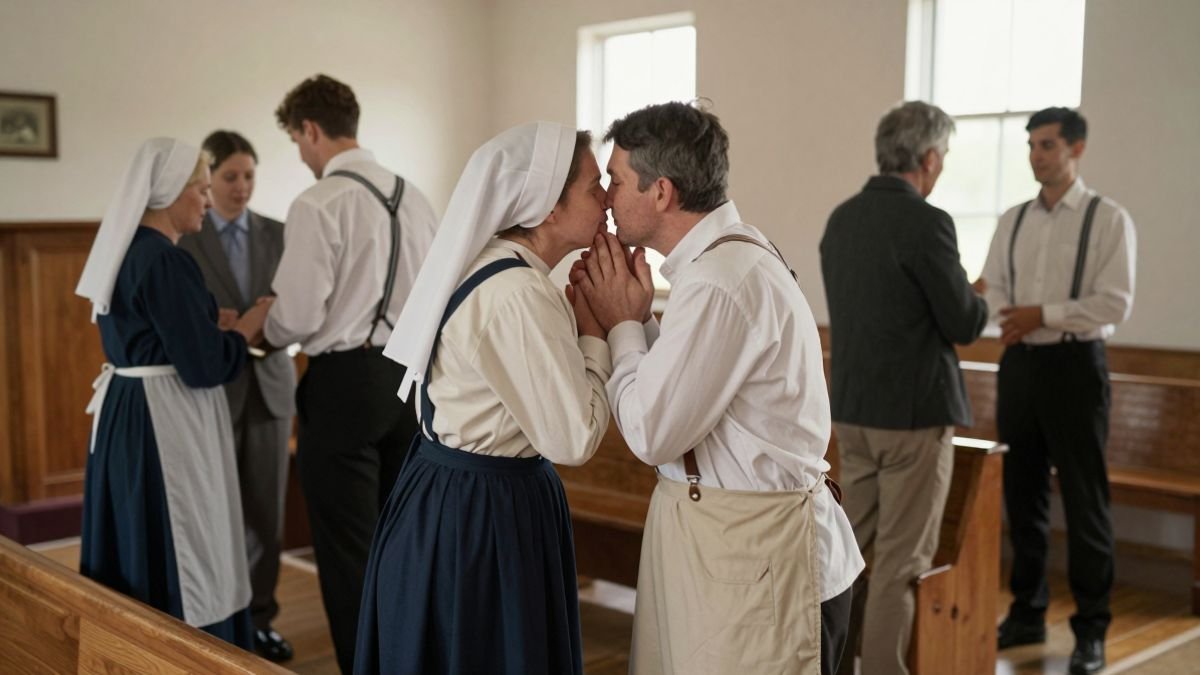
A video snippet circulates. A grainy photo trends. Suddenly, thousands are Googling “Holdeman Mennonite kissing ritual” and filling comment sections with speculation, shock, and a lot of misunderstanding. But what if the story you’re hearing isn’t the full picture—or even close to accurate?
The truth is, the “holy kiss” isn’t a secret ritual, a scandal, or anything salacious. It’s a centuries-old Christian practice rooted in scripture, observed by various faith communities around the world, and deeply misunderstood by outsiders. Let’s pull back the curtain, separate fact from sensationalism, and explore what the holy kiss actually means—and what it definitely doesn’t.
What people are hearing online
If you’ve stumbled across mentions of a “Holdeman Mennonite kissing ritual” on social media or forums, you’ve likely encountered one of two narratives: either breathless curiosity framing it as exotic or forbidden, or outright mockery treating it as bizarre.
The Holdeman Mennonites—formally known as the Church of God in Christ, Mennonite—are a conservative Anabaptist group. They practice plain dress, separation from mainstream culture, and maintain strict community guidelines. And yes, they practice the holy kiss, a greeting exchanged between members of the same gender during worship services.
But the online chatter often strips away context. It ignores the religious foundation, the boundaries involved, and the fact that this practice isn’t unique to one group. The result? A distorted image that feeds curiosity but starves understanding.
This is a textbook case of how cultural practices get sensationalized when they’re unfamiliar. And it’s a reminder that a few seconds of video or a single headline rarely tells the whole story.

The holy kiss in Christian history
The practice of the holy kiss—sometimes called the “kiss of peace” or “kiss of charity”—isn’t a modern invention. It appears multiple times in the New Testament, where early Christians are instructed to greet one another with a holy kiss.
Key biblical references include:
- Romans 16:16 – “Greet one another with a holy kiss.”
- 1 Corinthians 16:20 – “Greet one another with a holy kiss.”
- 1 Thessalonians 5:26 – “Greet all the brothers and sisters with a holy kiss.”
- 1 Peter 5:14 – “Greet one another with a kiss of love.”
In the early church, this was a standard greeting—a sign of fellowship, mutual respect, and spiritual kinship. It was never romantic or sexual. It was communal and sacred.
Over the centuries, many Christian denominations moved away from the literal practice. The Catholic Church, for example, evolved the holy kiss into the “sign of peace” (a handshake or nod). Orthodox Christians still exchange a ritual kiss during certain liturgical moments. And several Anabaptist groups—including some Mennonite, Brethren, and Apostolic Christian communities—have retained the practice in its original form.
The Holdeman Mennonites are among those who continue this tradition. For them, it’s not a quirk—it’s obedience to scripture and a tangible expression of Christian love and unity.
Why practices differ by community
Not all Mennonites practice the holy kiss. In fact, Mennonites are not a monolithic group. There are dozens of branches, each with different levels of conservatism, different interpretations of scripture, and different worship styles.
Here’s a quick breakdown:
- Old Order Mennonites and Holdeman Mennonites tend to retain traditional practices, including plain dress and the holy kiss.
- Conservative Mennonites may practice it selectively or only in certain congregations.
- Mainstream Mennonite churches (such as Mennonite Church USA) generally do not practice the holy kiss today.
Even within groups that do practice it, there are strict boundaries:
- The kiss is exchanged only between members of the same gender.
- It’s typically a brief kiss on the cheek or lips, done in a communal, non-romantic context.
- It happens during worship services, not casually in everyday life.
- It’s reserved for baptized, committed members of the church.
These guidelines exist precisely to maintain the sacred and non-sexual nature of the practice. It’s not a free-for-all. It’s a carefully observed ritual with deep spiritual meaning.
Understanding these distinctions matters. When people lump all Mennonites together or assume one video represents an entire faith tradition, they erase nuance and spread misinformation.

How to approach sources critically
In an age of viral content and algorithm-driven outrage, it’s easy to accept the first version of a story you see. But critical thinking is your best defense against sensationalism.
Here’s how to evaluate what you’re seeing:
Ask who’s telling the story. Is it a member of the community, a journalist with expertise, or a random account chasing clicks? Context matters.
Look for primary sources. Academic articles, interviews with community members, and denominational websites offer far more reliable information than TikTok comments.
Check the framing. Does the headline use words like “bizarre,” “secret,” or “shocking”? That’s a red flag. Sensational language often signals a lack of depth.
Consider the intent. Is the content trying to educate, or is it designed to provoke shock and shares? The latter prioritizes virality over truth.
Recognize your own biases. If a practice feels strange to you, that’s okay—but strangeness doesn’t equal wrongness. Curiosity should lead to learning, not judgment.
The Holdeman Mennonite holy kiss is a perfect example of how unfamiliarity breeds misunderstanding. What feels shocking to outsiders is, for practitioners, a normal and meaningful act of worship.
Respectful takeaway
The “Holdeman Mennonite kissing ritual” isn’t scandalous. It’s not a secret. It’s not weird for the sake of being weird.
It’s a religious practice with biblical roots, observed by a community that values tradition, scripture, and separation from secular culture. It’s practiced with clear boundaries, deep reverence, and zero romantic intent.
If you’re curious, that’s great. Curiosity is the first step toward understanding. But let that curiosity lead you to respectful research, not viral mockery.
Here’s what you can do next:
- Read about Anabaptist history and theology to understand the broader context.
- Seek out firsthand accounts from Mennonite communities (books, documentaries, interviews).
- Reflect on how your own cultural lens shapes your reactions to unfamiliar practices.
- Challenge sensationalist content when you see it—ask questions, share context, and model thoughtful engagement.
At the end of the day, the holy kiss is a reminder that faith is lived in diverse ways. What’s sacred to one community may be foreign to another, but that difference deserves respect, not ridicule.
So the next time you see a trending search term about a religious practice, pause. Ask questions. Dig deeper. You might just discover that the real story is far richer—and far more human—than the headline suggests.